Emergency call
+1 (800) 816-6677
+1 (800) 816-6677
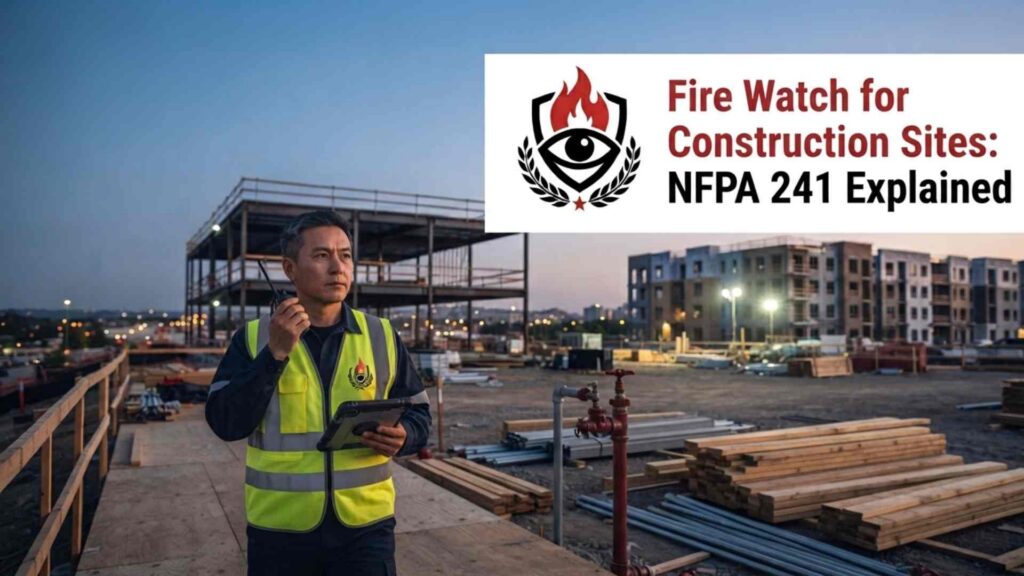
Construction sites burn. That’s not a rhetorical flourish, it’s a statistical reality. Fires in structures under construction or renovation cause hundreds of millions of dollars in losses annually, and the vast majority of them were preventable. NFPA 241 exists because construction sites present a fire risk profile unlike any other occupation and fire watch is central to managing that risk.
Completed buildings have fire protection built in: rated walls, sprinkler systems, smoke detectors, maintained egress paths. Construction sites have almost none of that until late in the project. What they do have is an abundance of fire hazards:
Add in the fact that construction sites are often unoccupied overnight and on weekends, and you have an environment where a small ignition can become a total loss before anyone notices.
NFPA 241, Standard for Safeguarding Construction, Alteration, and Demolition Operations, governs fire safety during construction. It covers everything from housekeeping and material storage to fire department access and, critically, fire watch.
Under NFPA 241, fire watch is required whenever any of the following conditions exist:
The code also requires that fire watch continue for 30 minutes after hot work operations conclude, that the guard have access to an operational fire extinguisher at all times, and that all activity be logged.
NFPA 241 isn’t the only standard in play on construction sites. OSHA 29 CFR 1926, the construction industry standard, contains its own hot work provisions that apply alongside NFPA requirements.
OSHA’s construction hot work standard requires that before any welding or cutting begins, the area is cleared of combustible materials or those materials are adequately shielded. A fire watch must be posted during the work and for 30 minutes after. The fire watch personnel must be trained to use extinguishing equipment and to respond appropriately if a fire starts.
For general contractors, the practical implication is clear: fire watch isn’t just a fire code issue it’s also an OSHA compliance issue. Violations can result in citations from both bodies independently.
A construction fire watch isn’t identical to a building fire watch. The hazards are different, the environment is more dynamic, and the risks change daily as work progresses. A qualified construction fire watch guard monitors:
On compliant job sites, hot work doesn’t just happen. It starts with a hot work permit, a documented authorization confirming the work area has been assessed, combustibles have been cleared or shielded, fire watch is arranged, and extinguishing equipment is in place.
The fire watch guard should be named on the hot work permit before work begins. This creates accountability and ensures the guard knows exactly what operations are taking place, where they’re happening, and what the post-work monitoring window looks like.
Skipping the permit process is one of the most common fire safety violations on construction sites, and it’s also one of the first things investigators look for after a fire. No permit, no documentation, no fire watch guard named that’s a pattern that generates serious liability.
Compliant documentation on construction sites includes:
On large sites with multiple subcontractors doing hot work simultaneously, this documentation burden compounds quickly. Many general contractors find it easier to manage through a dedicated fire watch service that handles all logging and provides centralized records.
GCs are ultimately responsible for fire safety on their sites, even when subcontractors are performing the hot work. That means you can’t assume your welding sub has a fire watch covered you need to verify it.
Best practice is to establish a site-wide fire watch protocol before work begins. This includes designating who handles fire watch coordination, which service provider will be used, how hot work permits are issued and tracked, and where fire watch logs are stored.
Include fire watch requirements in your subcontractor agreements explicitly. If a sub starts hot work without fire watch in place, that’s a site safety violation that reflects on the GC. Making it a contractual requirement creates accountability and gives you recourse if a sub cuts corners.
Finally, conduct periodic audits during the project. Job sites evolve, new hazards emerge, and the fire watch needs that existed at framing may look different during interior finish work. Review your fire safety plan at major project milestones.
Need a fire watch for a construction project? We provide NFPA 241 and OSHA-compliant guards for sites of all sizes. Request a construction fire watch quote today.