Emergency call
+1 (800) 816-6677
+1 (800) 816-6677
When a fire alarm system goes offline or a sprinkler gets shut down for maintenance, most building owners assume the risk is minimal, especially if the outage is planned and short-lived. That assumption has cost people their buildings, their businesses, and in the worst cases, their lives.
The National Fire Protection Association (NFPA) publishes a series of codes that define when a property is considered at elevated fire risk and what must be done about it. One of the most consistently misunderstood requirements in those codes is fire watch who needs it, when it kicks in, and what happens if it’s ignored. This guide breaks down the NFPA fire watch requirements across every major standard that applies, in plain language.
NFPA is a nonprofit organization that develops consensus-based codes and standards for fire safety. While NFPA codes aren’t federal law by default, they’ve been adopted into law by most U.S. states, counties, and municipalities. When your local fire marshal shows up during an impairment, they’re almost certainly referencing NFPA standards. For fire watch specifically, several NFPA codes come into play depending on your building type and the nature of the impairment. Knowing which one applies to your situation isn’t optional — it directly affects whether you’re compliant.
NFPA 72 is the National Fire Alarm and Signaling Code. It governs how fire alarm systems are installed, maintained, and monitored. Under this code, if a fire alarm system — or any significant portion of it — is taken out of service for more than four hours in a 24-hour period, a fire watch must be established.
That four-hour window is shorter than most people realize. A delayed part delivery, an extended diagnostic session, or a contractor who runs long can cross that threshold before anyone notices. Once it does, you’re required to have personnel physically patrolling the building, checking for fire conditions, and logging their activity.
The fire watch under NFPA 72 isn’t just a presence requirement — the guard must be dedicated solely to fire watch duties. They can’t double as a security officer handling access control, and they can’t be stationed at a desk. The intent is continuous, active monitoring of the building.
NFPA 25 covers the inspection, testing, and maintenance of water-based fire protection systems, including sprinklers and standpipes. When any sprinkler system is impaired — whether for repairs, renovations, or testing — the property owner must notify the fire department and the monitoring company, and implement fire watch immediately for anything beyond a minor, localized impairment.
A detail that catches many property managers off guard: fire watch under NFPA 25 doesn’t end the moment the sprinklers come back online. The guard must remain until the system has been fully restored, tested, and confirmed operational by a qualified technician.
NFPA 101, the Life Safety Code, applies to virtually every occupancy type — healthcare facilities, hotels, schools, assembly buildings — and ties fire watch requirements to occupancy-specific risk levels. In many cases it imposes stricter timelines than NFPA 72 alone.
Hospitals and nursing homes are classified as healthcare occupancies where residents can’t self-evacuate. Under NFPA 101, these facilities must initiate fire watch almost immediately when detection systems go down. Hotels, assembly halls, and high-rise buildings face similarly aggressive requirements.
Construction sites are among the most fire-prone environments that exist. Unfinished structures lack compartmentalization, fire suppression systems are often not yet installed, and the materials on site — lumber, insulation, adhesives, solvents — burn fast. NFPA 241 addresses this directly.
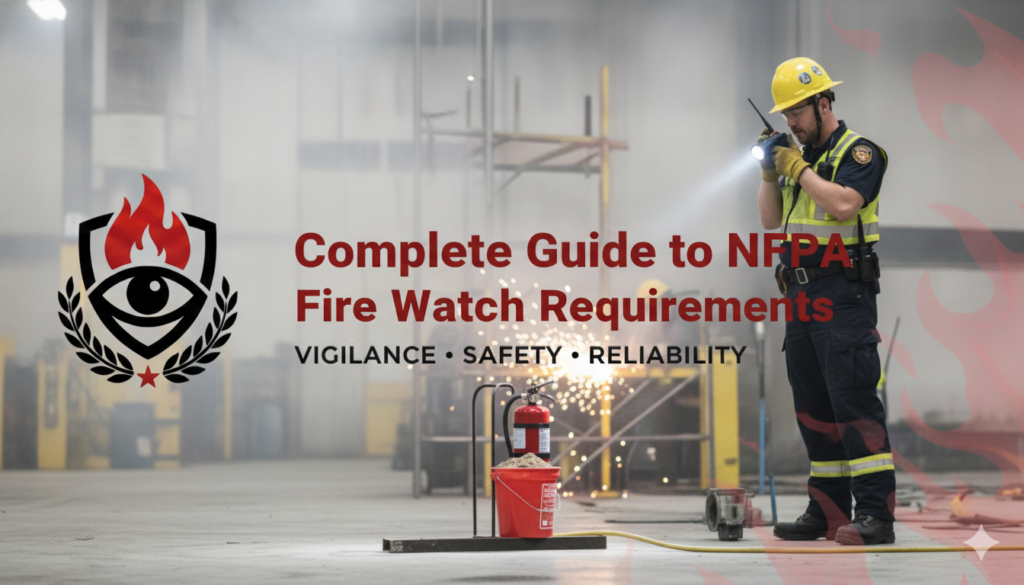
Under NFPA 241, fire watch is required on construction sites whenever hot work — welding, cutting, torch work — is taking place, and for at least 30 minutes after it concludes. General contractors are responsible for ensuring that fire watch is in place and that the watch personnel have the right equipment and training to respond.
NFPA 51B specifically governs hot work permits and fire prevention in welding, cutting, and allied processes. It requires that a fire watch remain on duty for 30 minutes after hot work ends — not because the work itself is dangerous at that point, but because smoldering materials can ignite long after the spark source is gone.
This 30-minute post-work requirement is frequently skipped on job sites where crews are trying to move fast. Fire marshals know this, and it’s one of the first things they check in a post-incident investigation.
Across all NFPA standards, fire watch logging is non-negotiable. A guard walking the building without documentation might as well not be there from a compliance standpoint. Logs must include:
These logs are your legal defense. If a fire occurs during an impairment and your logs are incomplete, insurers and investigators will treat that as negligence. Keep logs on-site and retain them for the period your jurisdiction requires — typically a minimum of one year.
Failing to implement required fire watch isn’t just a paperwork issue. Penalties vary by jurisdiction but commonly include fines starting in the hundreds and climbing quickly into the thousands per day of non-compliance. In cases where a fire occurs during an unprotected period, building owners face civil liability, insurance claim denials, and in some states, criminal exposure.
Beyond the legal and financial consequences, a fire in an unprotected building spreads faster, causes more damage, and is more likely to result in injury than one caught early by a trained, alert fire watch guard.
Not every security company that offers fire watch is actually qualified to provide it. When evaluating providers, confirm that guards are trained specifically in fire watch duties — not just general security. They should know patrol interval requirements, how to use portable fire extinguishers, how to complete compliant logs, and when to call the fire department.
Ask whether the company carries liability insurance specific to fire watch services, whether they can provide documentation of their training protocols, and whether they’ve worked with your type of occupancy before. A hotel fire watch operates differently from a hospital fire watch, which operates differently from a construction site.
Need fire watch deployed today? Contact us for a free, no-obligation quote. NFPA-compliant guards available 24/7 for commercial, industrial, and construction sites.